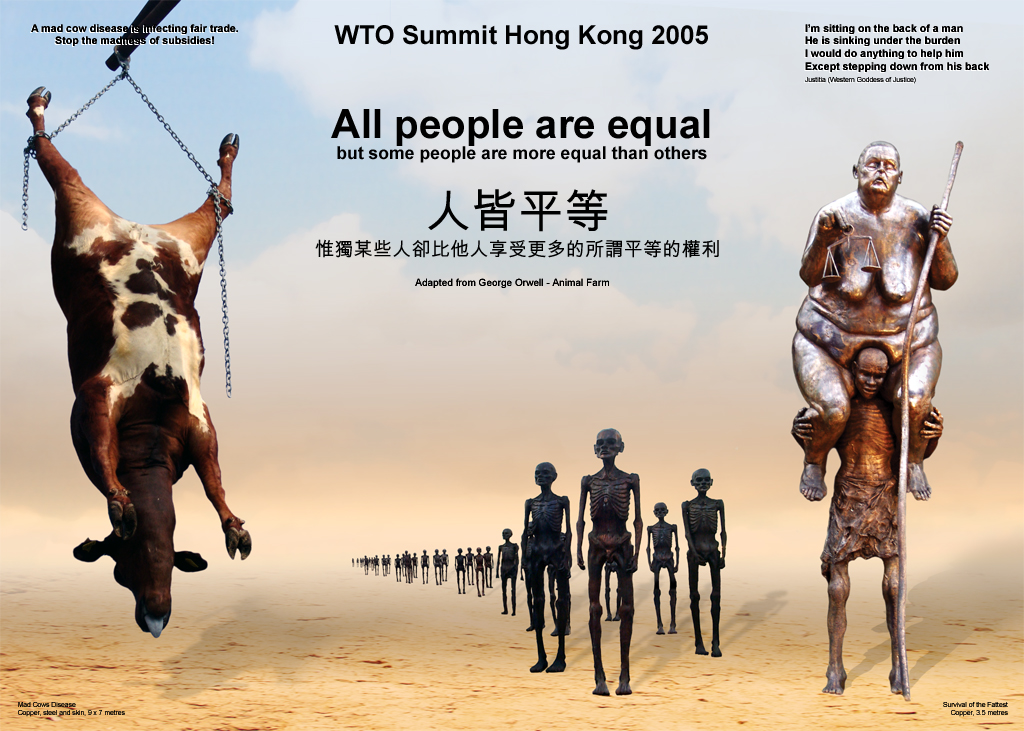
In the lasts months, International Organizations as well as NGOs multiplyed ewquests for additional foundings both in the short and in the long term in order to fight against food crisis negative impacts on the South.
World Bank was probably the most active institution. They propose an interesting action plan that couple both emergency intervenctions (mainly through financing food vauchers that are less distoritves than in-kind food aid) as erll as medium term investments and aid to improve productivity in the South. Mr. Zoellick call it a New Deal for the food crisis.
So far, so good. This time solutions proposed seems to be pragmatic and not biased toward a so-called neo-liberal ideology (as in the 80s and 90s). What is more, the debate with other organizations provide some other needed policy changes as, for example, more "policy space" for developing countries, the need to increase climate adaptation aid, etc.
The problem it that as Mr Diouf (FAO Secretary General) says these kind of programs have been created by the FAO (among others) many years ago. The problem is that founding by developed countries was not enough to implement them.
Once again, in this current cisis, developed countries do not answer quickly by providing new founding. They simply put on the table some small grants in order to demonstrate to theyr citizens that they are doing something.
We need to change the system by reducing the dependency of the UN and other international institutions on developed countries "special contribution" (in fact, "compulsory" contribution are quite low and allow only to run these institutions). The ideas to found a global development program with a small tax on airplanes tickets or on financial transactions need to be further explored and implemented.
food crisis ODA North-South relations agriculture aid
May 14, 2008
Still Waiting for Developed Countries Commitments and Action on Food Crisis


March 12, 2008
Is Official Development Assistance Effective to Boost Growth? Palliative vs. Development Economics
Even if these practitioners are driven by good intentions the results of ODA in the last fifty years are extremely disappointing. In fact, if we look at the ODA impacts on growth we see that, as Rajan and Subramanian demonstrate, “there is no robust positive relationship between aid and growth”.
I propose in this blog some reasons that can explain this failure that it is mainly caused by the last thirty years policies:
- ODA, notably multilateral, was used in the 80s and 90s to promote Washington Consensus policies. Liberalizing trade provoked in many countries the destruction of their industrial sector (1). The outcome was the slowdown of growth, unemployment and increase of poverty. These impacts were amplified by privatizations and “less-state” policies.
- There are also some external factors that reduced growth and create poverty. The more important ones were probably: debt service, oil prices, global economic crises and huge increase of developed countries agricultural subsidies. However, the last two elements are linked to policies adopted by developing countries.
- ODA, mainly provided by bilateral donors, often follow the political and economic interest of the donor. For example, ODA tends to maintain the colonial division of labour with developing countries producing only raw materials and handicraft. What is more, ODA now deals more with emergency situations than with development.
- ODA is more focused on what Erik Reinert (see the “interesting to read” section on this blog) call “palliative” economics than development economics. In fact, aid community prefers to try to solve the worst negative impacts of development failures in developing countries (as increase of disease, health care, poverty in very peripheral areas, etc). They chose to treat the symptoms of the disease instead of its causes.

I could conclude that ODA is useless and we need to simply eliminate it. Nevertheless, I think that we can reform it. ODA can become a genuine instrument for development.
The following changes, some of them already discussed by the ODA community, can contribute to this objective:
- ODA should be linked by a real ownership of developing countries that should use it as a tool in broader development strategy. Donors discuss on this issue but they are very far to achieve it. For example, PRSP have been criticized because developing countries poorly choose how to spend resources.
- Donors should spend less money in “palliative” policies and more in development policies. We should invest more in industrialization and advanced services development. In fact, only by developing these sectors a country can have enough resources to invest durably in health care and education. Furthermore, as Reinert, demonstrate only the development of an industrial sector can help to durably improve farmers living conditions. Donors often continue to implement the same kind of project. What is needed is to think outside the box notably to use new technologies for development.
- Donors invest a huge amount of resources in the so-called “good governance”. This is a waste of money. In fact, if we look at the most successful former developing countries (as Korea, Singapore, etc.), they were not good examples of “good governance”: there were corruption, rent-seeking, authoritarian governments, etc. Nevertheless, they succeed and after reaching a level in their development, they choose to implement democracy, human rights, anti-corruption policies, etc. Implementing these policies in LDC is a waste of money and could be counterproductive in terms of development. In the early phases of development, there is only a good- or bad-for-business governance.
- National decision-makers are the most well placed to design a development strategy and to choose what and when policies should be implemented. International experts, with few exceptions, tends to propose (and often to impose) one-size-fit-all approaches based on econometric models. We should adopt a new approach on development. Rodrik call this approach experimental. We need to learn more form past experiences and from our (of a developing country decision-maker) mistakes. We should learn more on experiences of successful countries than form econometric unrealistic models. What is more, each country has its specificities and a one-size-fit-all strategy did not exist.
- We should use more tools that history demonstrate that they are effective. For example, it is better to improve South-South integration than North-South Free Trade Agreements. In general, we need to better understand how the successful Marshal Plan worked in Europe and replicate it in the developing worldthrough ODA. I will explain its main characteristics in another post.
In conclusion, ODA donors should assess the failure of development aid and think seriously on how to improve it. They should surpass old (and new) ideological thinking and adopt a more experimental approach that takes into consideration past experiences and assessments of development results. Development and not palliative measures should be the focus of ODA. We need better development economics scholars that can think outside the box and criticize past and current policies. We also need to think on aid and its inter-linkages with global governance and international engagements. In fact, it is useless to promote cotton industry in Benin if the US gave huge subsidies to their cotton farmers.
Foot Notes
(1)For more information on trade and development issues look at my previous post.
Economics North-South Relations ODA development aid foreign aid
March 3, 2008
Doha « Development » Round likely to fail to meet 2008 deadlines
According to the World Trade Organization’s Director General Pascal Lamy, the negotiators can succeed to complete the negotiation Round before the end of 2008. For this reason, there is a project to organize a mini-ministerial conference around Easter.
Nevertheless, even if some negotiators tend to be relatively optimistic, an agreement in the following months is quite unlikely. In fact, there is huge divides between negotiators in agriculture and, even more, in the industrial sector negotiations (NAMA). The draft released few weeks ago by the chair of the negotiation committees fails to propose an agreement acceptable by all the Membership. What is more, they leave many points in suspense. Furthermore, the negotiations comprehend also other issues where is still difficult to reach a consensus.
Even if ministers will come to Geneva the next weeks they will probably not succeed to solve the huge amount of issues that are still unresolved.

Beyond these disagreements among negotiators, the main cause that explain the many deadlines, that were missed by negotiators on the last years, is that developed countries refuse to acknowledge by their actions that this Round is about development and, according to the negotiation agenda (2001 Doha Declaration,) it should readjust the balance of the international trading system. In fact, notably the last trade negotiation Round (the Uruguay Round) increased the inequality of the international trading system. Developing countries were forced to liberalize many sectors and make important concessions (services, Intellectual Property, Agriculture) without receive any valuable improvements in the sectors where they have offensive interests (notably agriculture).
From many years during the Doha Round negotiations, developed countries thought that, at the end of the day, they would succeed to impose an agreement to the developing countries. They did not understand that the world changed and that a coalition of developing countries driven by emerging countries will resist and show its offensive interests. Trade negotiations are any more a question of finding a deal between US and EU but they become more multilateral. To reach an agreement, developed countries should understand that this time they will be constrained to make some concessions to developing countries. This is the price to keep an institution like the WTO, that plays an important role in regulating the world economy by law, alive.
What is more, this lack of will (and of good faith) by developed countries, cause huge difficulties to reach agreement on the issues that are very important for their citizens as environmental and social standards. In fact, even if these issues are defendables in terms of their potential positive impact on sustaiable developement and, under some conditions, to what we called co-development, developing countries refused to negotiate it. They think that is simply another way for developed countries to protect their markets. This reaction is understandable considering the mercantilist way in which developed countries negotiate the issues that matte rfor developing countries (notably for the poorest) (see, for example, Special Products Issues or flexibilites on NAMA negotiations).
In conclusion, if we are optimist an agreement will be reached before the end of 2009. However, the Uruguay conclusion teach us that surprises and strong accelerations in negotiations are always possible even in the most unlikely situation.
Codevelopment doha round north-south WTO global governance trade